Blue Velvet Damselfish (Paraglyphidodon oxyodon)
Blue Velvet Damselfish (Paraglyphidodon oxyodon)
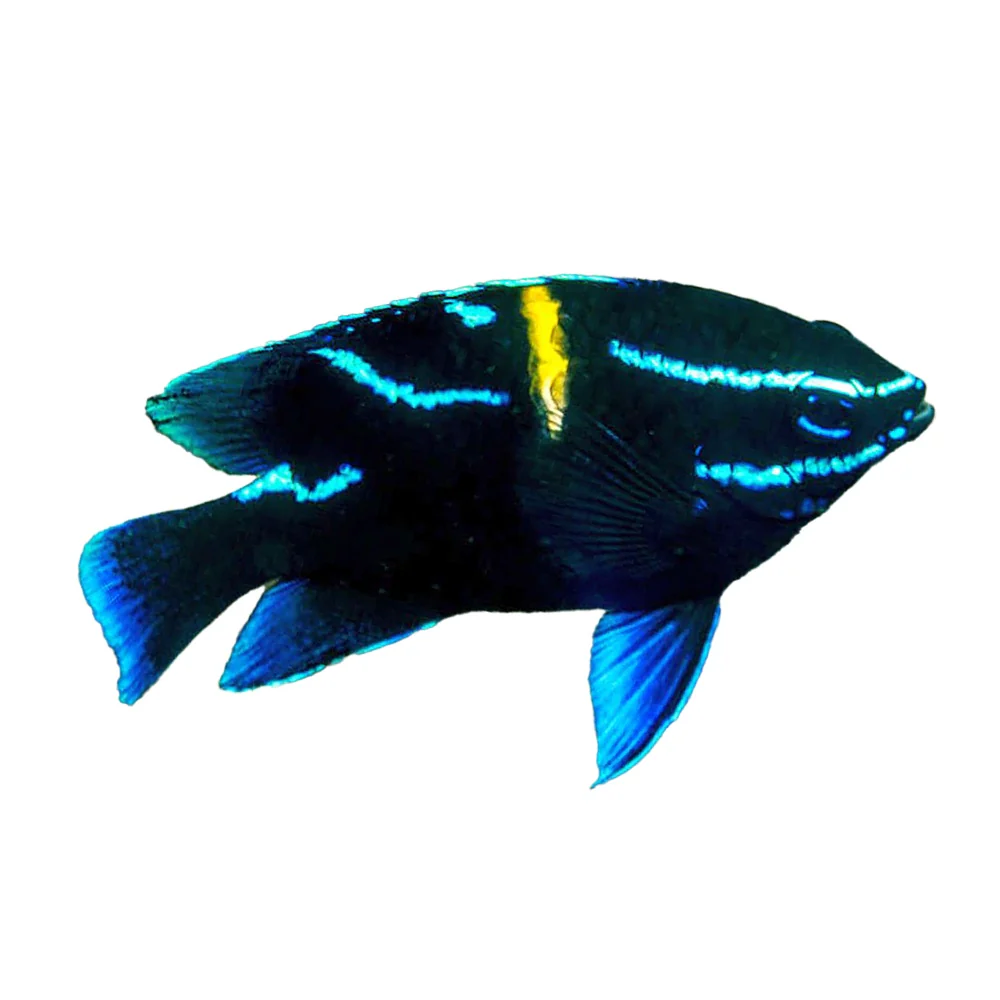
The Blue Velvet Damselfish, also known as the Blue-streak Damselfish or Javanese Damselfish, is one of the most stunning examples of how much a fish can change as it matures. As juveniles, they are famous for their "neon" aesthetic, featuring a jet-black body with electric-blue horizontal stripes that look like they are glowing. However, prospective owners should be aware that this "velvet" beauty eventually fades into a much larger, much more aggressive adult.
Key Information
-
Common Names: Blue Velvet Damselfish, Blue-streak Damselfish, Javanese Damselfish
-
Scientific Name: Paraglyphidodon oxyodon
-
Origin: Indo-Pacific (Indonesia to the Philippines)
-
Max Size: 15 cm (approx. 6 inches) — Quite large for a damselfish
-
Lifespan: 5–10+ years
-
Temperament: Highly Aggressive (especially as adults)
-
Diet: Omnivore – Primarily feeds on zooplankton and algae
-
Care Level: Very Easy
Appearance: The Great Transformation
The Blue Velvet Damselfish undergoes a significant "ugly duckling" (or rather, "beautiful duckling") phase in reverse:
-
Juvenile: Jet-black body with two to three electric blue stripes on the face and back, and a vibrant white-to-yellow spot on the dorsal fin. This is the stage most commonly seen in stores.
-
Adult: The brilliant blue stripes eventually disappear. The adult becomes a stark, dark grey-to-black fish with a yellow-white vertical band behind the head. While still a handsome, "tough-looking" fish, it loses its neon glow entirely.
Behaviour & Tank Compatibility
-
Aggression Level: Among the most aggressive damselfish in the hobby. As they grow, they become extremely territorial and will not hesitate to attack fish twice their size, including Tangs and Triggerfish.
-
The "Bully" Factor: They are known for rearranging small pieces of rockwork and sand to suit their territory, and they may harass any newcomers added to the tank after they have established a home.
-
Reef Safe: 100% Reef Safe. They do not eat corals or clams, but their aggressive behavior can stress out other reef inhabitants.
-
Tank Mates: Best kept with other highly aggressive or robust fish like Dottybacks, Large Angelfish, and Triggerfish. Avoid peaceful species like Gobies, Blennies, or Firefish.
Ideal Tank Setup
-
Tank Size: A minimum of 115L (30 Gallons) is required for a juvenile, but a 200L–300L (55–75 Gallon) tank is much better for an adult to help disperse its aggression.
-
Rockwork: Provide substantial live rock with large caves and tunnels. This allows the fish to claim a territory, which is essential for its well-being (and the safety of its neighbors).
-
Filtration: Like most damsels, they are incredibly hardy, but they thrive in well-maintained water with moderate flow.
-
Lid: They are fast, powerful swimmers and can jump if involved in a territorial dispute. A secure lid is mandatory.
Why Choose the Blue Velvet Damselfish?
The Blue Velvet Damselfish is for the hobbyist who wants a nearly indestructible fish with a high-impact look (at least while young). It is an excellent choice for a "rough and tumble" tank where other fish might be too delicate. If you appreciate the transition from a neon-striped juvenile to a bold, shadowy adult—and you have the aggressive tank mates to match its energy—the Blue Velvet is a striking and resilient choice.
Product Information
Product Information
Shipping & Returns
Shipping & Returns
Blue Velvet Damselfish (Paraglyphidodon oxyodon)
Blue Velvet Damselfish (Paraglyphidodon oxyodon)
Blue Velvet Damselfish (Paraglyphidodon oxyodon)
The Blue Velvet Damselfish, also known as the Blue-streak Damselfish or Javanese Damselfish, is one of the most stunning examples of how much a fish can change as it matures. As juveniles, they are famous for their "neon" aesthetic, featuring a jet-black body with electric-blue horizontal stripes that look like they are glowing. However, prospective owners should be aware that this "velvet" beauty eventually fades into a much larger, much more aggressive adult.
Key Information
-
Common Names: Blue Velvet Damselfish, Blue-streak Damselfish, Javanese Damselfish
-
Scientific Name: Paraglyphidodon oxyodon
-
Origin: Indo-Pacific (Indonesia to the Philippines)
-
Max Size: 15 cm (approx. 6 inches) — Quite large for a damselfish
-
Lifespan: 5–10+ years
-
Temperament: Highly Aggressive (especially as adults)
-
Diet: Omnivore – Primarily feeds on zooplankton and algae
-
Care Level: Very Easy
Appearance: The Great Transformation
The Blue Velvet Damselfish undergoes a significant "ugly duckling" (or rather, "beautiful duckling") phase in reverse:
-
Juvenile: Jet-black body with two to three electric blue stripes on the face and back, and a vibrant white-to-yellow spot on the dorsal fin. This is the stage most commonly seen in stores.
-
Adult: The brilliant blue stripes eventually disappear. The adult becomes a stark, dark grey-to-black fish with a yellow-white vertical band behind the head. While still a handsome, "tough-looking" fish, it loses its neon glow entirely.
Behaviour & Tank Compatibility
-
Aggression Level: Among the most aggressive damselfish in the hobby. As they grow, they become extremely territorial and will not hesitate to attack fish twice their size, including Tangs and Triggerfish.
-
The "Bully" Factor: They are known for rearranging small pieces of rockwork and sand to suit their territory, and they may harass any newcomers added to the tank after they have established a home.
-
Reef Safe: 100% Reef Safe. They do not eat corals or clams, but their aggressive behavior can stress out other reef inhabitants.
-
Tank Mates: Best kept with other highly aggressive or robust fish like Dottybacks, Large Angelfish, and Triggerfish. Avoid peaceful species like Gobies, Blennies, or Firefish.
Ideal Tank Setup
-
Tank Size: A minimum of 115L (30 Gallons) is required for a juvenile, but a 200L–300L (55–75 Gallon) tank is much better for an adult to help disperse its aggression.
-
Rockwork: Provide substantial live rock with large caves and tunnels. This allows the fish to claim a territory, which is essential for its well-being (and the safety of its neighbors).
-
Filtration: Like most damsels, they are incredibly hardy, but they thrive in well-maintained water with moderate flow.
-
Lid: They are fast, powerful swimmers and can jump if involved in a territorial dispute. A secure lid is mandatory.
Why Choose the Blue Velvet Damselfish?
The Blue Velvet Damselfish is for the hobbyist who wants a nearly indestructible fish with a high-impact look (at least while young). It is an excellent choice for a "rough and tumble" tank where other fish might be too delicate. If you appreciate the transition from a neon-striped juvenile to a bold, shadowy adult—and you have the aggressive tank mates to match its energy—the Blue Velvet is a striking and resilient choice.
Product Information
Product Information
Shipping & Returns
Shipping & Returns
Description
Blue Velvet Damselfish (Paraglyphidodon oxyodon)
The Blue Velvet Damselfish, also known as the Blue-streak Damselfish or Javanese Damselfish, is one of the most stunning examples of how much a fish can change as it matures. As juveniles, they are famous for their "neon" aesthetic, featuring a jet-black body with electric-blue horizontal stripes that look like they are glowing. However, prospective owners should be aware that this "velvet" beauty eventually fades into a much larger, much more aggressive adult.
Key Information
-
Common Names: Blue Velvet Damselfish, Blue-streak Damselfish, Javanese Damselfish
-
Scientific Name: Paraglyphidodon oxyodon
-
Origin: Indo-Pacific (Indonesia to the Philippines)
-
Max Size: 15 cm (approx. 6 inches) — Quite large for a damselfish
-
Lifespan: 5–10+ years
-
Temperament: Highly Aggressive (especially as adults)
-
Diet: Omnivore – Primarily feeds on zooplankton and algae
-
Care Level: Very Easy
Appearance: The Great Transformation
The Blue Velvet Damselfish undergoes a significant "ugly duckling" (or rather, "beautiful duckling") phase in reverse:
-
Juvenile: Jet-black body with two to three electric blue stripes on the face and back, and a vibrant white-to-yellow spot on the dorsal fin. This is the stage most commonly seen in stores.
-
Adult: The brilliant blue stripes eventually disappear. The adult becomes a stark, dark grey-to-black fish with a yellow-white vertical band behind the head. While still a handsome, "tough-looking" fish, it loses its neon glow entirely.
Behaviour & Tank Compatibility
-
Aggression Level: Among the most aggressive damselfish in the hobby. As they grow, they become extremely territorial and will not hesitate to attack fish twice their size, including Tangs and Triggerfish.
-
The "Bully" Factor: They are known for rearranging small pieces of rockwork and sand to suit their territory, and they may harass any newcomers added to the tank after they have established a home.
-
Reef Safe: 100% Reef Safe. They do not eat corals or clams, but their aggressive behavior can stress out other reef inhabitants.
-
Tank Mates: Best kept with other highly aggressive or robust fish like Dottybacks, Large Angelfish, and Triggerfish. Avoid peaceful species like Gobies, Blennies, or Firefish.
Ideal Tank Setup
-
Tank Size: A minimum of 115L (30 Gallons) is required for a juvenile, but a 200L–300L (55–75 Gallon) tank is much better for an adult to help disperse its aggression.
-
Rockwork: Provide substantial live rock with large caves and tunnels. This allows the fish to claim a territory, which is essential for its well-being (and the safety of its neighbors).
-
Filtration: Like most damsels, they are incredibly hardy, but they thrive in well-maintained water with moderate flow.
-
Lid: They are fast, powerful swimmers and can jump if involved in a territorial dispute. A secure lid is mandatory.
Why Choose the Blue Velvet Damselfish?
The Blue Velvet Damselfish is for the hobbyist who wants a nearly indestructible fish with a high-impact look (at least while young). It is an excellent choice for a "rough and tumble" tank where other fish might be too delicate. If you appreciate the transition from a neon-striped juvenile to a bold, shadowy adult—and you have the aggressive tank mates to match its energy—the Blue Velvet is a striking and resilient choice.