Bluefin Damselfish (Neoglyphidodon melas)
Bluefin Damselfish (Neoglyphidodon melas)
The Bluefin Damselfish, also known as the Bowtie Damselfish or Royal Damselfish, is a species that carries a significant "disclaimer." While it is one of the most beautiful and distinctively patterned juveniles in the marine trade, it undergoes a radical transformation as it matures. It is a robust, hardy fish, but its extreme territoriality in adulthood makes it suitable only for specific types of large, aggressive systems.
Key Information
-
Common Names: Bluefin Damselfish, Bowtie Damselfish, Royal Damselfish, Zulu Damsel
-
Scientific Name: Neoglyphidodon melas
-
Origin: Indo-Pacific (Red Sea and East Africa to the Great Barrier Reef)
-
Max Size: 18 cm (approx. 7 inches) — one of the largest damselfish species.
-
Lifespan: 2–5 years (Captive); potentially longer in specialized systems.
-
Temperament: Aggressive to Highly Aggressive; extremely territorial as an adult.
-
Diet: Omnivore – In the wild, they are known to eat soft corals and even Tridacna clam feces.
-
Care Level: Easy (Very hardy, but difficult to manage socially).
Appearance: The Radical Transformation
This species is famous for its dramatic color shift from youth to maturity:
-
Juvenile: Breathtakingly beautiful. It features a shimmering white/silver body with a bright yellow dorsal surface and yellow-edged tail lobes. Its pelvic and anal fins are a striking electric blue with black margins.
-
Adult: The vibrant colors disappear entirely. As it matures, the fish turns into a solid, uniform dark blue-to-jet black. While it has a sleek, "royal" silhouette, it loses the neon-yellow and blue highlights of its youth.
Behaviour & Tank Compatibility
-
Aggression: As a juvenile, it is "feisty." As an adult, it becomes a dominant bully. It will claim a large portion of the tank and fiercely attack intruders.
-
Reef Safe (with Caution): Unlike many damsels, this species is not strictly reef-safe. Adults are known to eat soft corals and may nip at the mantles of Tridacna clams.
-
Tank Mates: Should only be housed with large, assertive fish that can hold their own, such as Tangs, Large Angelfish, Dottybacks, and Triggerfish. Never keep them with small, peaceful fish like Gobies or Firefish.
-
Social Structure: Best kept singly. Keeping multiple Bluefin Damsels will almost certainly lead to the death of the submissive fish unless the tank is massive (1,000L+).
Ideal Tank Setup
-
Tank Size: A minimum of 200L (55 Gallons) is required for a single specimen, though 300L–500L is recommended to help dilute its territorial aggression toward other fish.
-
Rockwork: Provide substantial live rock with large caves. They need a "castle" to defend.
-
Feeding: They are not picky. Offer a variety of meaty frozen foods (mysis, krill, squid) and high-quality herbivore pellets or flakes containing Spirulina.
-
Lid: They are powerful, fast swimmers and can easily jump if they get into a high-speed chase. A secure lid is mandatory.
Why Choose the Bluefin Damselfish?
The Bluefin Damselfish is for the hobbyist who runs a large, aggressive FOWLR (Fish Only With Live Rock) system and wants a fish that is nearly "bulletproof." Its hardiness is legendary—it can survive environmental shifts that would kill most other marine life. If you have a tank full of "bruisers" like Triggers and Large Angels, and you don't mind the eventual transition to a solid black adult, this is a bold and resilient choice.
Product Information
Product Information
Shipping & Returns
Shipping & Returns
Bluefin Damselfish (Neoglyphidodon melas)
Bluefin Damselfish (Neoglyphidodon melas)
Bluefin Damselfish (Neoglyphidodon melas)
The Bluefin Damselfish, also known as the Bowtie Damselfish or Royal Damselfish, is a species that carries a significant "disclaimer." While it is one of the most beautiful and distinctively patterned juveniles in the marine trade, it undergoes a radical transformation as it matures. It is a robust, hardy fish, but its extreme territoriality in adulthood makes it suitable only for specific types of large, aggressive systems.
Key Information
-
Common Names: Bluefin Damselfish, Bowtie Damselfish, Royal Damselfish, Zulu Damsel
-
Scientific Name: Neoglyphidodon melas
-
Origin: Indo-Pacific (Red Sea and East Africa to the Great Barrier Reef)
-
Max Size: 18 cm (approx. 7 inches) — one of the largest damselfish species.
-
Lifespan: 2–5 years (Captive); potentially longer in specialized systems.
-
Temperament: Aggressive to Highly Aggressive; extremely territorial as an adult.
-
Diet: Omnivore – In the wild, they are known to eat soft corals and even Tridacna clam feces.
-
Care Level: Easy (Very hardy, but difficult to manage socially).
Appearance: The Radical Transformation
This species is famous for its dramatic color shift from youth to maturity:
-
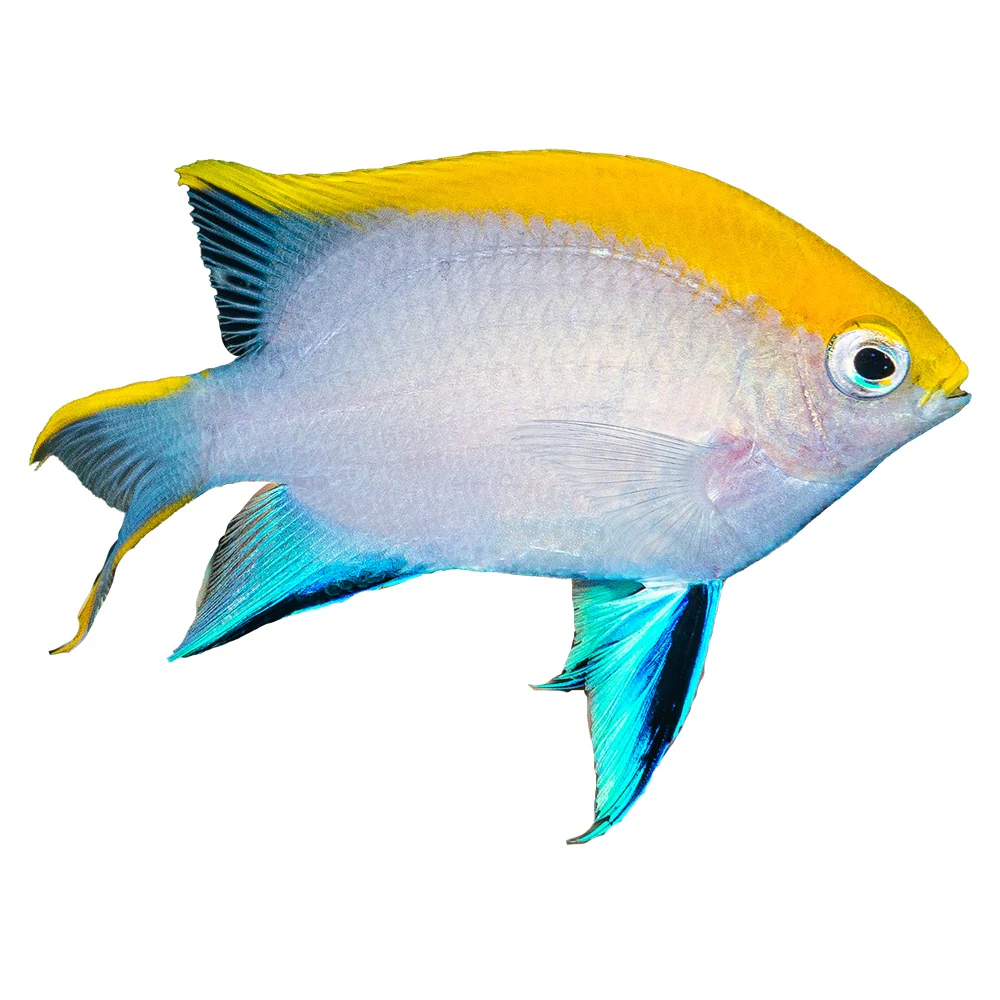
Juvenile: Breathtakingly beautiful. It features a shimmering white/silver body with a bright yellow dorsal surface and yellow-edged tail lobes. Its pelvic and anal fins are a striking electric blue with black margins.
-
Adult: The vibrant colors disappear entirely. As it matures, the fish turns into a solid, uniform dark blue-to-jet black. While it has a sleek, "royal" silhouette, it loses the neon-yellow and blue highlights of its youth.
Behaviour & Tank Compatibility
-
Aggression: As a juvenile, it is "feisty." As an adult, it becomes a dominant bully. It will claim a large portion of the tank and fiercely attack intruders.
-
Reef Safe (with Caution): Unlike many damsels, this species is not strictly reef-safe. Adults are known to eat soft corals and may nip at the mantles of Tridacna clams.
-
Tank Mates: Should only be housed with large, assertive fish that can hold their own, such as Tangs, Large Angelfish, Dottybacks, and Triggerfish. Never keep them with small, peaceful fish like Gobies or Firefish.
-
Social Structure: Best kept singly. Keeping multiple Bluefin Damsels will almost certainly lead to the death of the submissive fish unless the tank is massive (1,000L+).
Ideal Tank Setup
-
Tank Size: A minimum of 200L (55 Gallons) is required for a single specimen, though 300L–500L is recommended to help dilute its territorial aggression toward other fish.
-
Rockwork: Provide substantial live rock with large caves. They need a "castle" to defend.
-
Feeding: They are not picky. Offer a variety of meaty frozen foods (mysis, krill, squid) and high-quality herbivore pellets or flakes containing Spirulina.
-
Lid: They are powerful, fast swimmers and can easily jump if they get into a high-speed chase. A secure lid is mandatory.
Why Choose the Bluefin Damselfish?
The Bluefin Damselfish is for the hobbyist who runs a large, aggressive FOWLR (Fish Only With Live Rock) system and wants a fish that is nearly "bulletproof." Its hardiness is legendary—it can survive environmental shifts that would kill most other marine life. If you have a tank full of "bruisers" like Triggers and Large Angels, and you don't mind the eventual transition to a solid black adult, this is a bold and resilient choice.
Original: $14.30
-65%$14.30
$5.00Product Information
Product Information
Shipping & Returns
Shipping & Returns
Description
Bluefin Damselfish (Neoglyphidodon melas)
The Bluefin Damselfish, also known as the Bowtie Damselfish or Royal Damselfish, is a species that carries a significant "disclaimer." While it is one of the most beautiful and distinctively patterned juveniles in the marine trade, it undergoes a radical transformation as it matures. It is a robust, hardy fish, but its extreme territoriality in adulthood makes it suitable only for specific types of large, aggressive systems.
Key Information
-
Common Names: Bluefin Damselfish, Bowtie Damselfish, Royal Damselfish, Zulu Damsel
-
Scientific Name: Neoglyphidodon melas
-
Origin: Indo-Pacific (Red Sea and East Africa to the Great Barrier Reef)
-
Max Size: 18 cm (approx. 7 inches) — one of the largest damselfish species.
-
Lifespan: 2–5 years (Captive); potentially longer in specialized systems.
-
Temperament: Aggressive to Highly Aggressive; extremely territorial as an adult.
-
Diet: Omnivore – In the wild, they are known to eat soft corals and even Tridacna clam feces.
-
Care Level: Easy (Very hardy, but difficult to manage socially).
Appearance: The Radical Transformation
This species is famous for its dramatic color shift from youth to maturity:
-
Juvenile: Breathtakingly beautiful. It features a shimmering white/silver body with a bright yellow dorsal surface and yellow-edged tail lobes. Its pelvic and anal fins are a striking electric blue with black margins.
-
Adult: The vibrant colors disappear entirely. As it matures, the fish turns into a solid, uniform dark blue-to-jet black. While it has a sleek, "royal" silhouette, it loses the neon-yellow and blue highlights of its youth.
Behaviour & Tank Compatibility
-
Aggression: As a juvenile, it is "feisty." As an adult, it becomes a dominant bully. It will claim a large portion of the tank and fiercely attack intruders.
-
Reef Safe (with Caution): Unlike many damsels, this species is not strictly reef-safe. Adults are known to eat soft corals and may nip at the mantles of Tridacna clams.
-
Tank Mates: Should only be housed with large, assertive fish that can hold their own, such as Tangs, Large Angelfish, Dottybacks, and Triggerfish. Never keep them with small, peaceful fish like Gobies or Firefish.
-
Social Structure: Best kept singly. Keeping multiple Bluefin Damsels will almost certainly lead to the death of the submissive fish unless the tank is massive (1,000L+).
Ideal Tank Setup
-
Tank Size: A minimum of 200L (55 Gallons) is required for a single specimen, though 300L–500L is recommended to help dilute its territorial aggression toward other fish.
-
Rockwork: Provide substantial live rock with large caves. They need a "castle" to defend.
-
Feeding: They are not picky. Offer a variety of meaty frozen foods (mysis, krill, squid) and high-quality herbivore pellets or flakes containing Spirulina.
-
Lid: They are powerful, fast swimmers and can easily jump if they get into a high-speed chase. A secure lid is mandatory.
Why Choose the Bluefin Damselfish?
The Bluefin Damselfish is for the hobbyist who runs a large, aggressive FOWLR (Fish Only With Live Rock) system and wants a fish that is nearly "bulletproof." Its hardiness is legendary—it can survive environmental shifts that would kill most other marine life. If you have a tank full of "bruisers" like Triggers and Large Angels, and you don't mind the eventual transition to a solid black adult, this is a bold and resilient choice.