Pearl Toby Pufferfish (Canthigaster Margaritata)
Pearl Toby Pufferfish (Canthigaster margaritata)
The Pearl Toby Pufferfish, also known as the Mauritius Toby, is one of the most exquisite "dwarf" puffers in the marine world. While many puffers grow to the size of a football, the Pearl Toby stays conveniently small, offering a high-definition "galaxy" pattern and a massive amount of personality. It is an intelligent, curious fish that will quickly learn to recognize you, but like all Tobies, it has a mischievous side when it comes to "nipping."
Key Information
-
Common Names: Pearl Toby, Pearly Puffer, Mauritius Puffer
-
Scientific Name: Canthigaster margaritata
-
Origin: Indo-Pacific (Red Sea to the Line Islands)
-
Max Size: 10–12 cm (approx. 4.5 inches)
-
Lifespan: 5–10 years
-
Temperament: Semi-aggressive; a notorious fin-nipper
-
Diet: Omnivore – Specialist in crunchy invertebrates and algae
-
Care Level: Easy
Appearance & Identification
The Pearl Toby is often described as a "living jewel":
-
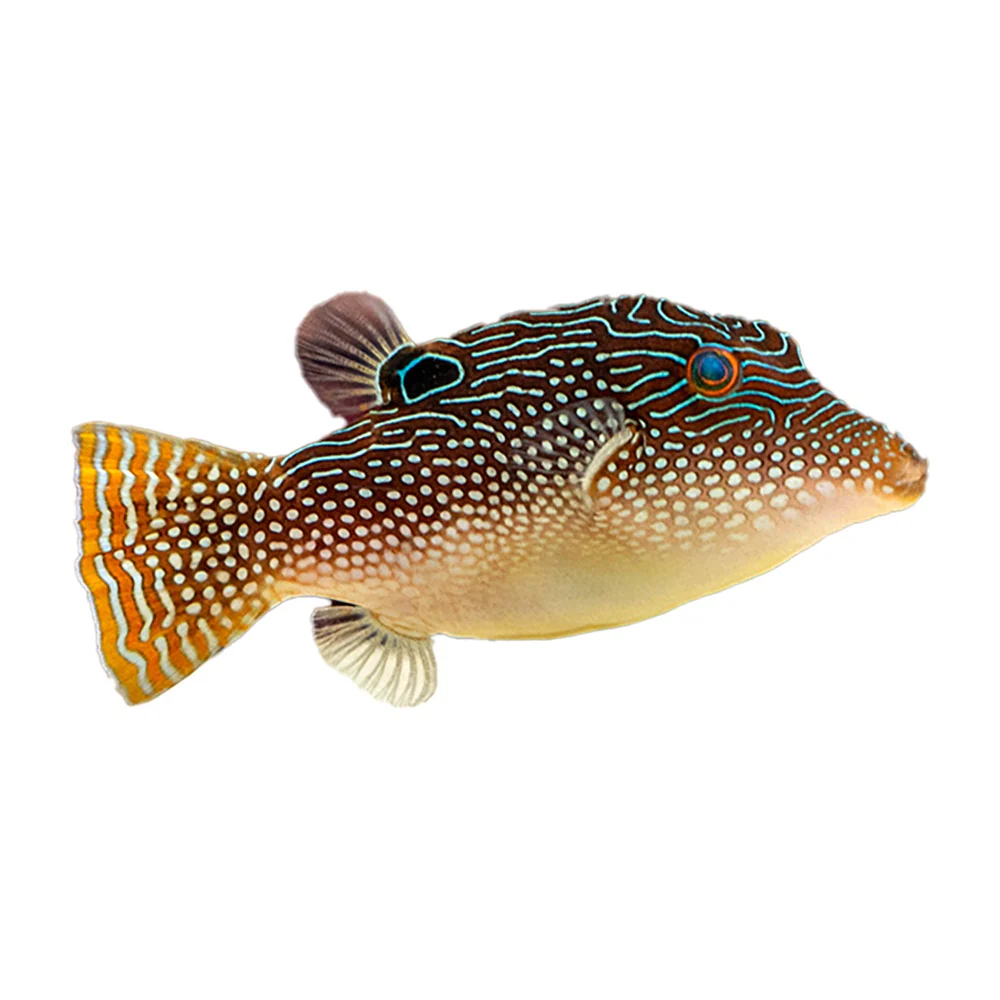
The "Pearl" Pattern: The body is a deep reddish-brown to orange, covered in a dense "starfield" of neon blue-to-white spots (the pearls).
-
The "Circuitry": Its face and dorsal ridge feature intricate neon blue lines that look like a motherboard's traces.
-
The Eyes: Like all puffers, their eyes move independently, shimmering with a metallic green and gold hue.
-
Body Shape: It has a classic "Toby" silhouette—pointy snout, boxy body, and a tail fin that it often keeps folded until it needs a burst of speed.
Behaviour: The "Inquisitive Nipper"
-
Intelligence: This is one of the "smartest" small fish you can own. It will watch you through the glass, track your movements, and eventually learn that you are the source of food.
-
Reef Safe (Caution): Technically NOT Reef Safe. While they won't eat your corals whole, they are "tasters." They will frequently nip at SPS coral tips, clam mantles, and fleshy LPS.
-
Invertebrate Risk: They are "crunchers." They will eat snails, small crabs, and ornamental shrimp. If you have a clean-up crew, the Pearl Toby will likely view them as an expensive buffet.
-
Social Structure: Best kept singly. They are very territorial toward other Canthigaster species.
Ideal Tank Setup
-
Tank Size: A minimum of 115L (30 Gallons). They are active explorers and need plenty of rockwork to weave through.
-
Rockwork: Provide a complex aquascape. Tobies love to investigate every nook and cranny for hidden snails or worms.
-
Feeding: This is the key to their health. They need "crunchy" foods to wear down their ever-growing teeth (fused into a beak). Offer shell-on mysis, chopped clams, cockles, and krill. They also appreciate dried seaweed (Nori).
-
Filtration: Because they are messy eaters and have a high metabolism, a strong protein skimmer is necessary to maintain water quality.
Why Choose the Pearl Toby Puffer?
The Pearl Toby is for the hobbyist who wants a "Pet Fish" in a small package. It doesn't just swim; it interacts with its environment. If you aren't planning on keeping a high-end coral reef or a delicate clean-up crew, this puffer is one of the most rewarding inhabitants you can find.
Product Information
Product Information
Shipping & Returns
Shipping & Returns
Pearl Toby Pufferfish (Canthigaster Margaritata)
Pearl Toby Pufferfish (Canthigaster Margaritata)
Pearl Toby Pufferfish (Canthigaster margaritata)
The Pearl Toby Pufferfish, also known as the Mauritius Toby, is one of the most exquisite "dwarf" puffers in the marine world. While many puffers grow to the size of a football, the Pearl Toby stays conveniently small, offering a high-definition "galaxy" pattern and a massive amount of personality. It is an intelligent, curious fish that will quickly learn to recognize you, but like all Tobies, it has a mischievous side when it comes to "nipping."
Key Information
-
Common Names: Pearl Toby, Pearly Puffer, Mauritius Puffer
-
Scientific Name: Canthigaster margaritata
-
Origin: Indo-Pacific (Red Sea to the Line Islands)
-
Max Size: 10–12 cm (approx. 4.5 inches)
-
Lifespan: 5–10 years
-
Temperament: Semi-aggressive; a notorious fin-nipper
-
Diet: Omnivore – Specialist in crunchy invertebrates and algae
-
Care Level: Easy
Appearance & Identification
The Pearl Toby is often described as a "living jewel":
-
The "Pearl" Pattern: The body is a deep reddish-brown to orange, covered in a dense "starfield" of neon blue-to-white spots (the pearls).
-
The "Circuitry": Its face and dorsal ridge feature intricate neon blue lines that look like a motherboard's traces.
-
The Eyes: Like all puffers, their eyes move independently, shimmering with a metallic green and gold hue.
-
Body Shape: It has a classic "Toby" silhouette—pointy snout, boxy body, and a tail fin that it often keeps folded until it needs a burst of speed.
Behaviour: The "Inquisitive Nipper"
-
Intelligence: This is one of the "smartest" small fish you can own. It will watch you through the glass, track your movements, and eventually learn that you are the source of food.
-
Reef Safe (Caution): Technically NOT Reef Safe. While they won't eat your corals whole, they are "tasters." They will frequently nip at SPS coral tips, clam mantles, and fleshy LPS.
-
Invertebrate Risk: They are "crunchers." They will eat snails, small crabs, and ornamental shrimp. If you have a clean-up crew, the Pearl Toby will likely view them as an expensive buffet.
-
Social Structure: Best kept singly. They are very territorial toward other Canthigaster species.
Ideal Tank Setup
-
Tank Size: A minimum of 115L (30 Gallons). They are active explorers and need plenty of rockwork to weave through.
-
Rockwork: Provide a complex aquascape. Tobies love to investigate every nook and cranny for hidden snails or worms.
-
Feeding: This is the key to their health. They need "crunchy" foods to wear down their ever-growing teeth (fused into a beak). Offer shell-on mysis, chopped clams, cockles, and krill. They also appreciate dried seaweed (Nori).
-
Filtration: Because they are messy eaters and have a high metabolism, a strong protein skimmer is necessary to maintain water quality.
Why Choose the Pearl Toby Puffer?
The Pearl Toby is for the hobbyist who wants a "Pet Fish" in a small package. It doesn't just swim; it interacts with its environment. If you aren't planning on keeping a high-end coral reef or a delicate clean-up crew, this puffer is one of the most rewarding inhabitants you can find.
Original: $57.21
-65%$57.21
$20.02Product Information
Product Information
Shipping & Returns
Shipping & Returns
Description
Pearl Toby Pufferfish (Canthigaster margaritata)
The Pearl Toby Pufferfish, also known as the Mauritius Toby, is one of the most exquisite "dwarf" puffers in the marine world. While many puffers grow to the size of a football, the Pearl Toby stays conveniently small, offering a high-definition "galaxy" pattern and a massive amount of personality. It is an intelligent, curious fish that will quickly learn to recognize you, but like all Tobies, it has a mischievous side when it comes to "nipping."
Key Information
-
Common Names: Pearl Toby, Pearly Puffer, Mauritius Puffer
-
Scientific Name: Canthigaster margaritata
-
Origin: Indo-Pacific (Red Sea to the Line Islands)
-
Max Size: 10–12 cm (approx. 4.5 inches)
-
Lifespan: 5–10 years
-
Temperament: Semi-aggressive; a notorious fin-nipper
-
Diet: Omnivore – Specialist in crunchy invertebrates and algae
-
Care Level: Easy
Appearance & Identification
The Pearl Toby is often described as a "living jewel":
-
The "Pearl" Pattern: The body is a deep reddish-brown to orange, covered in a dense "starfield" of neon blue-to-white spots (the pearls).
-
The "Circuitry": Its face and dorsal ridge feature intricate neon blue lines that look like a motherboard's traces.
-
The Eyes: Like all puffers, their eyes move independently, shimmering with a metallic green and gold hue.
-
Body Shape: It has a classic "Toby" silhouette—pointy snout, boxy body, and a tail fin that it often keeps folded until it needs a burst of speed.
Behaviour: The "Inquisitive Nipper"
-
Intelligence: This is one of the "smartest" small fish you can own. It will watch you through the glass, track your movements, and eventually learn that you are the source of food.
-
Reef Safe (Caution): Technically NOT Reef Safe. While they won't eat your corals whole, they are "tasters." They will frequently nip at SPS coral tips, clam mantles, and fleshy LPS.
-
Invertebrate Risk: They are "crunchers." They will eat snails, small crabs, and ornamental shrimp. If you have a clean-up crew, the Pearl Toby will likely view them as an expensive buffet.
-
Social Structure: Best kept singly. They are very territorial toward other Canthigaster species.
Ideal Tank Setup
-
Tank Size: A minimum of 115L (30 Gallons). They are active explorers and need plenty of rockwork to weave through.
-
Rockwork: Provide a complex aquascape. Tobies love to investigate every nook and cranny for hidden snails or worms.
-
Feeding: This is the key to their health. They need "crunchy" foods to wear down their ever-growing teeth (fused into a beak). Offer shell-on mysis, chopped clams, cockles, and krill. They also appreciate dried seaweed (Nori).
-
Filtration: Because they are messy eaters and have a high metabolism, a strong protein skimmer is necessary to maintain water quality.
Why Choose the Pearl Toby Puffer?
The Pearl Toby is for the hobbyist who wants a "Pet Fish" in a small package. It doesn't just swim; it interacts with its environment. If you aren't planning on keeping a high-end coral reef or a delicate clean-up crew, this puffer is one of the most rewarding inhabitants you can find.